Solutions 5.3 Optimized Strcat.C
Original Chapter 2 code
Show the code
void strcat(char s[], char t[]) {
    int i = 0, j = 0;
    while (s[i] != '\0')  // 找到 s 的结尾
        i++;
    while ((s[i++] = t[j++]) != '\0') // 复制 t
        ;
}
Solution of Exercise 5.2
Show the code
#include <stdio.h>

void strcat_ptr(char *s, char *t);

int main(void)
{
  char s[100] = "This is the first string";
  char t[] = ", this second string!";

  strcat_ptr(s, t);

  puts(s);

  return 0;
}

// Concatenate t to end of s; s must be big enough.
void strcat_ptr(char *s, char *t)
{
  // Find the end of s
  while (*s)
      ++s;

  // copy t to the end of s
  while (*s++ = *t++)
    ;
}
strcat 教学版逐行解析
整体代码
void strcat(char s[], char t[]) {
    int i = 0, j = 0;
    while (s[i] != '\0')  // 找到 s 的结尾
        i++;
    while ((s[i++] = t[j++]) != '\0') // 复制 t
        ;
}
1. void strcat(char s[], char t[]) {
void→ 函数返回类型,表示这个函数没有返回值。 (标准库里的strcat实际上返回char*,这里只是教学版本。)strcat→ 函数名。char s[]→ 形参,看起来是“字符数组”,但在函数参数里 会退化成char*指针。- 所以
s实际上是指向字符串首元素的指针。
- 所以
char t[]→ 同理,指向另一个字符串。
👉 参数语义:s = 目标字符串;t = 要追加的字符串。
2. int i = 0, j = 0;
- 定义两个整型变量
i、j。 - 并初始化为 0。
- 这里
i用来扫描目标字符串s的下标;j用来扫描源字符串t的下标。
3. while (s[i] != '\0')
while (条件)→ 当条件为真时,循环执行。s[i]→ 访问数组元素,下标运算符[],等价于*(s + i)。'\0'→ C 字符串的结束标志(ASCII 值 0 的字符)。- 条件:
s[i] != '\0'→ 表示“当前字符不是字符串结尾”。
4. i++;
i++→ 后缀自增运算符,等价于i = i + 1。- 这里用来向后移动下标,直到遇到
'\0'。 - 作用:找到 s 的末尾。
5. while ((s[i++] = t[j++]) != '\0')
逐部分拆解:
(s[i++] = t[j++])→t[j++]:先取t[j]的值,再让j自增。s[i++] = ...:把这个值赋给s[i],再让i自增。- 结果是把
t[j]的字符复制到s[i],然后两个下标都往后移一位。
!= '\0'→ 检查刚复制的字符是不是'\0'(字符串结束标志)。如果不是
'\0'→ 循环继续,复制下一个字符。如果是
'\0'→ 循环结束,完成追加。
6. ;
- 这是一个 空语句。
- 因为
while的循环体就一行,而且逻辑已经在条件里完成,所以写一个分号表示“循环体什么都不做”。 - 实际循环体的动作就是条件里的“赋值 + 判断”。
总结
找到 s 的末尾:
while (s[i] != '\0') i++;从 t 复制到 s 的末尾,直到
'\0'为止:while ((s[i++] = t[j++]) != '\0');
最终效果:t 的内容被接到 s 后面,形成新的字符串。 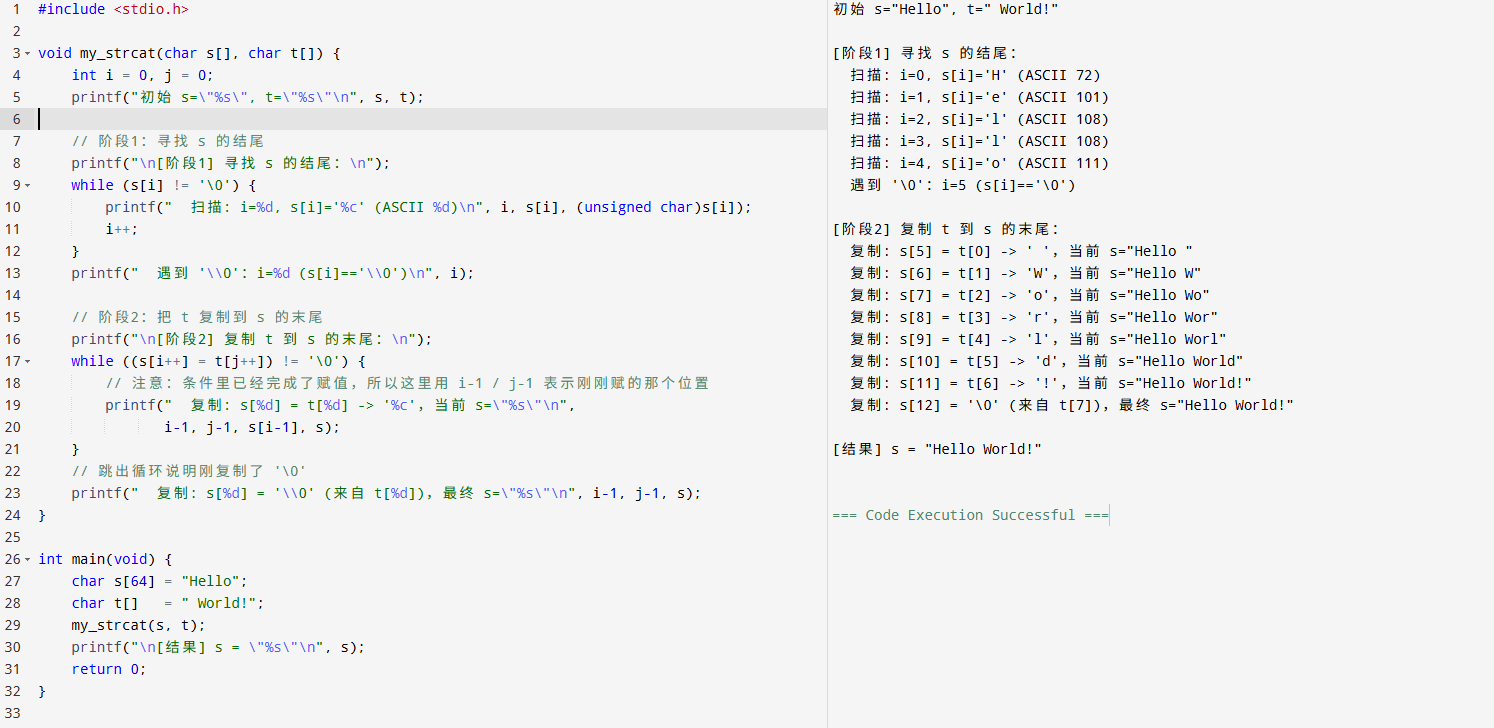 —
—